وسط تهليلات " الله اكبر " حرق أكثر من 50 كنيسة فى أثيوبيا
حرق أكثر من 50 كنيسة فى أثيوبيا
اليوم السابع 15/3/2011م
كتبت نهى محمود
شن عدد من المسلحين هجوماً على ما لا يقل عن 50 كنيسة فى إثيوبيا، وذلك فى إطار
تصاعد العنف ضد المسيحيين من قبل من يسمون أنفسهم بالجهاديين.
وذكرت مجلة "ذا نيو أمريكان" أنه بالرغم من أن أغلبية الشعب الإثيوبى مسيحى،
إلا أن عمليات التصعيد ضد المسيحيين تتزايد، مشيرة إلى حرق عدد من منازل
المسيحيين بشكل مستمر بدءاً من 2 مارس الماضى.
وأوضحت المجلة أنه مثل هذه الهجمات بدأت بعد اتهام المسيحيين بتدنيس القرآن،
فيما خرج حشد من المسلمين يهللون "الله أكبر"، ويحرقون عدداً من الكنائس، على
حد زعمها.
Muslims Burn Coptic Churches in Ethiopia
WRITTEN BY JAMES HEISER
MONDAY, 14 MARCH 2011 17:38
An attack by militant Muslims which has thus far destroyed at least a dozen
churches may signal an expansion in anti-Christian violence in Ethiopia as
the next front in the recent escalation of the Jihad’s war against
Christianity.
Although the majority of Ethiopian Christians are Coptic, having membership
in the Ethiopian Orthodox Tewahedo Church, the latest anti-Christian
violence has targeted Protestant churches in the area of Asendabo,
approximately 250 kilometers southwest of Addis Ababa. According to press
reports, a dozen Protestant churches and the homes of at least two pastors —
as well as numerous other Christian homes and properties — have been
destroyed in a wave of violence which began on March 2. It should be noted
that other sources indicate that the damage may be far worse than the more
conservative number cited; according to Reuters and a story at WorldNetDaily
the number of churches destroyed may stand at more than 50.
According to a report from AsiaNews:
Muslims [began] their attacks on March 2, after accusing the Christians of
having desecrated the Koran. A crowd of Muslims shouting "Allahu akbar" (God
is greatest) attacked three evangelical churches[,] setting them on fire.
When the federal police arrived, the riots continued, and agents,
overwhelmed by numbers, were unable to prevent other places of worship
suffering the same fate.
With every passing day the violence has not decreased. According to sources,
a Christian was killed, several others were injured and more than a dozen
homes and places of prayer have been burned including a school, an orphanage
and the offices of a church. Nearly three thousand Christians have been
displaced by the wave of violence. A local Christian leader told to
International Christian Concern that the attacks were organized by members
of Kwarej, a radical Islamic group which aims to create a Muslim state in
the majority Coptic country. Those responsible for the attacks come from
different regions of the country, including those close to Somalia.
Currently, Muslims make up only roughly one-third of the population of
Ethiopia, and they live primarily in a few regions of the country. According
to census data published by the Ethiopian government, 43.5 percent of
Ethiopians are members of the Orthodox (Coptic) Church, while another 18.6
percent are members of various Protestant churches and less than one percent
are members of the Roman Catholic Church. Much of the Muslim minority (which
accounts for 33.9 percent of the overall population of Ethiopia) is found
within a few areas of Ethiopia — including the Afar and Somali regions,
where they constitute over 95 percent of the population. The scene of the
recent violence, the town of Asendabo, is in the Oromia region, which the
census report indicates has a population which is almost evenly divided
between Christians (48.7 percent) and Muslims (47.5).
According to WorldNetDaily, the supposed act of “desecration” which served
as the excuse for the latest anti-Christian violence may have been the work
of a Muslim agent provocateur:
International Christian Concern's Jonathan Racho has been in contact with a
pastor in Ethiopia who confirms that more than 50 churches have been burned
— along with a school, an orphanage and an office.
Racho said the wave of arson was touched off by Muslims framing Christians
for desecrating a Quran. "The Muslims desecrated a Quran and put it in a
church compound and then accused Christians of desecrating a Quran, then
started attacking," Racho said. "Since this happened, since it happened in a
part of Ethiopia where Muslims have the majority, the police failed to
protect the Christians.
"So the Muslim mobs were able to carry out attacks in many cities," he said.
Meles Zenawi, the Prime Minister of Ethiopia, blames a Kwarej (or Kawarja)
Muslim sect for the violence. Reuters reports:
Meles told a news conference late on Saturday that "elements of the Kawarja
sect and other extremists" had been preaching religious intolerance in the
area.
"The government has been trying to stop the violence. That has been done
quite successfully in spite of the property damage and the death of one
Ethiopian," he said. International Christian Concern said Kawarja, about
whom little is known, aimed to set up an Islamic state in mainly Christian
Ethiopia, where Muslims make up a quarter of the population. ...
Meles said it was hard to prosecute Islamic extremists. "We knew that they
were peddling this ideology of intolerance, but it was not possible for us
to stop them administratively because they are within their rights," he
said.
"If we can find some association between what they are doing by way of
preaching and what happened by way of violence, then of course we can take
them to court."
As reported previously for The New American, the timing of attacks on
churches in Ethiopia coincides closely with similar attacks in the town of
Soul, Egypt. In Soul, the incident which was followed by at attack on
Christians was allegedly a controversy over a relationship between a Coptic
man and a Muslim woman. In both Egypt and Ethiopia, the excuse for violent
attacks on Christian churches was an alleged infraction of Islamic Sharia
law.
At present, there is no direct evidence linking the attacks in Ethiopia to
other anti-Christian violence which has erupted in the past few months — no
direct link, that is, other than that which has been consistently present in
Islamic doctrine. The close ties between the Copts in Ethiopia and in Egypt
presumably leave them with few illusions about the plight of Christians
living under an Islamic state.
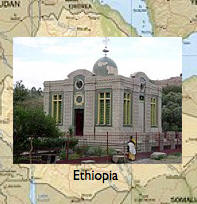
Graphic: Ethiopian church
Release date : 3/15/2011
 Encyclopedia
-
أنسكلوبيديا
Encyclopedia
-
أنسكلوبيديا